

Lore Library
This is you tranquil athenaeum for questions about the artwork, your cards, or the Quiet Wild Deck.
The Quiet Wild is a place of observation. It exists wherever we pause long enough to notice what is moving inside us. The thoughts we carry, the feelings that rise and fall, and the quiet truths that often go unheard in the noise of daily life. This collection of cards offers small moments from that world. Each one pairs an animal or landscape with a short reflection drawn from the rhythms of the natural world. They are not meant to predict the future or deliver answers. Instead, they offer a way to pause, notice, and consider what might be unfolding within your own experience. The images in this collection are drawn from original art work and photography taken over many years by Alicia McNally, now gathered together within the world of The Quiet Wild. There is no single correct way to use these cards, only the approach that feels meaningful to you.
Ways To Begin:
The simplest practice
is also
the most powerful.
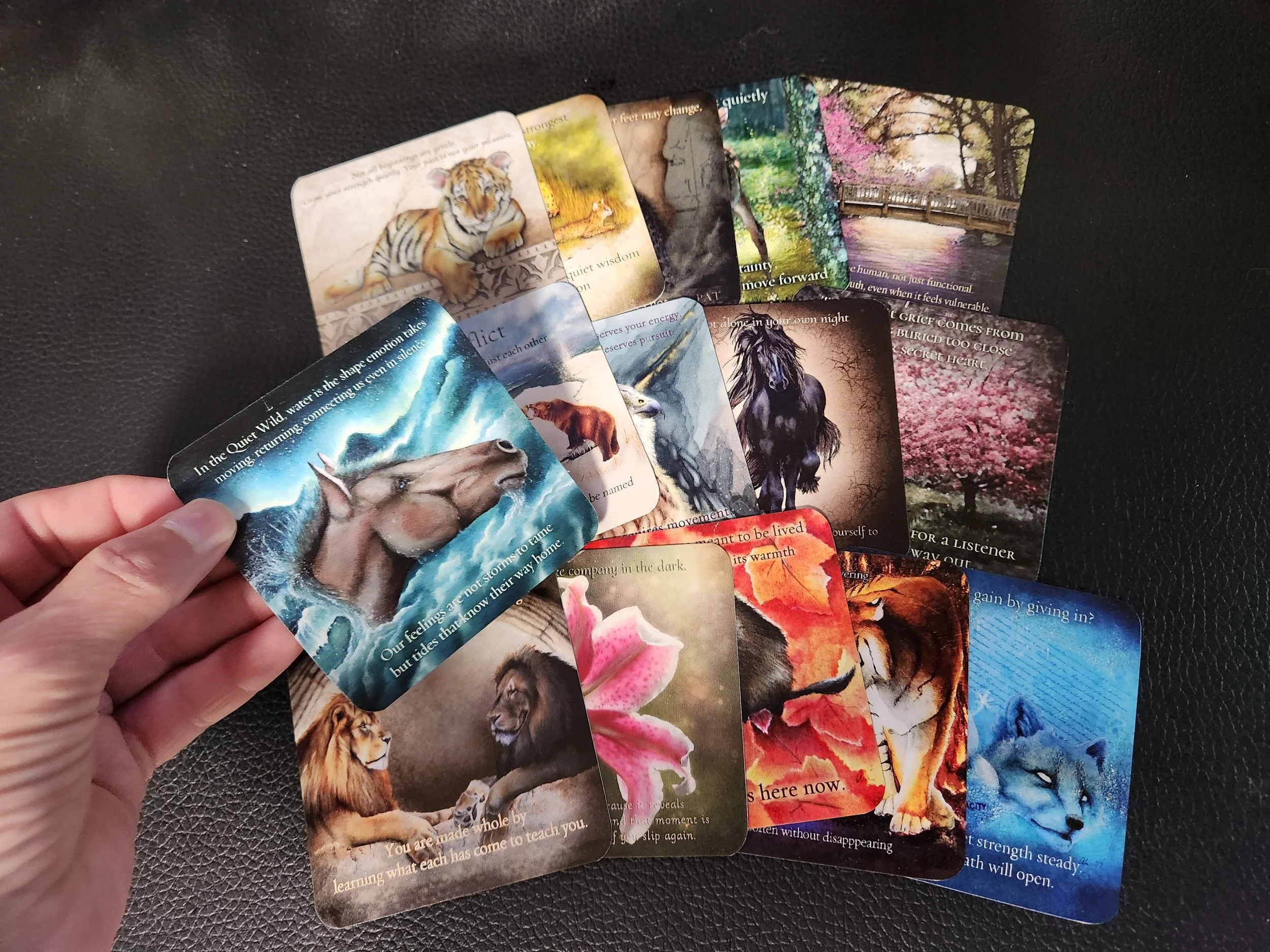
Shuffle the cards and draw one. Read the short story it has to share. Then sit with that reflective prompt, Notice what thoughts, memories or feelings arise. There is nothing that you need to solve Simply observe. These insights may give you information as to what unconsciously affects your mood, reactions, and decisions as you go through your day.
Some people enjoy drawing a card each morning as a way to begin their day, with a moment of awareness. Others return to the cards only when they feel the need for reflection or perspective. Both approaches are equally valid. You may also choose to hang them on your fridge at home or at work as a personal reminder as you start and go about your day. The small 3×3 size means the cards can travel easily with you and can be given as small gifts, or traded with others. A small 4×6 photo album works great as a storage center for cards that are not currently in you circulation. PDF’s of the cards individual lore will be here for download.
The Core 15
A single small journey…
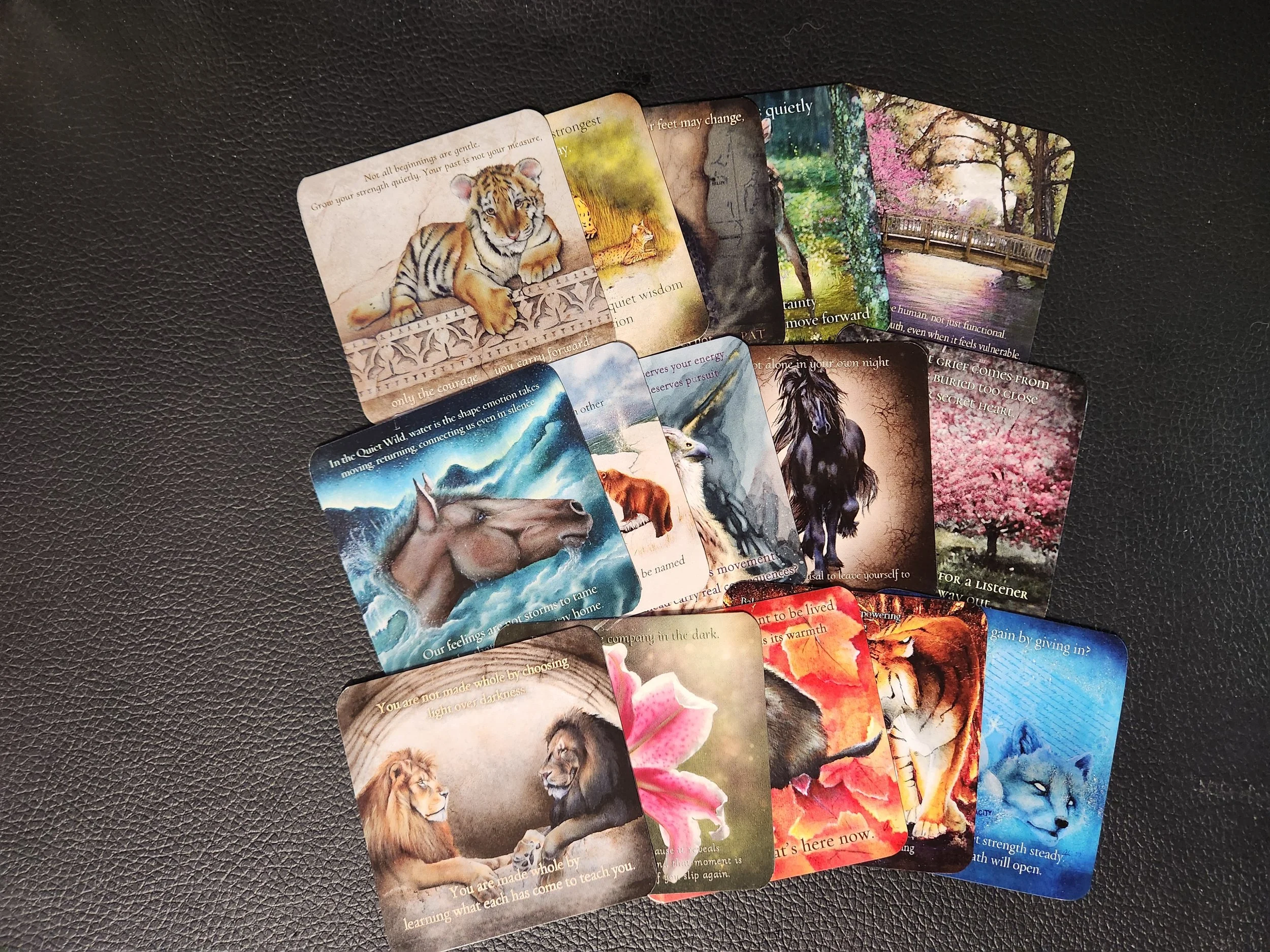
The Core 15 cards are set as their own opening to your larger internal world. From Akyra The Early Watcher to The Tenacity of the Arctic Fox the Core 15 explore the emotional arc of:
Arrival/Beginnings
Opening/Challenges
Reckoning/Loss
Return/Growth
Integration/Wisdom
Again these are meant as a reflection deck, to help you to focus your thoughts and reframe situations so that you can grow from your past rather than to slip into a pattern of constant self criticism, and doubt. A new perspective can also help shape your internal dialog which is critical for internal strength and growth.
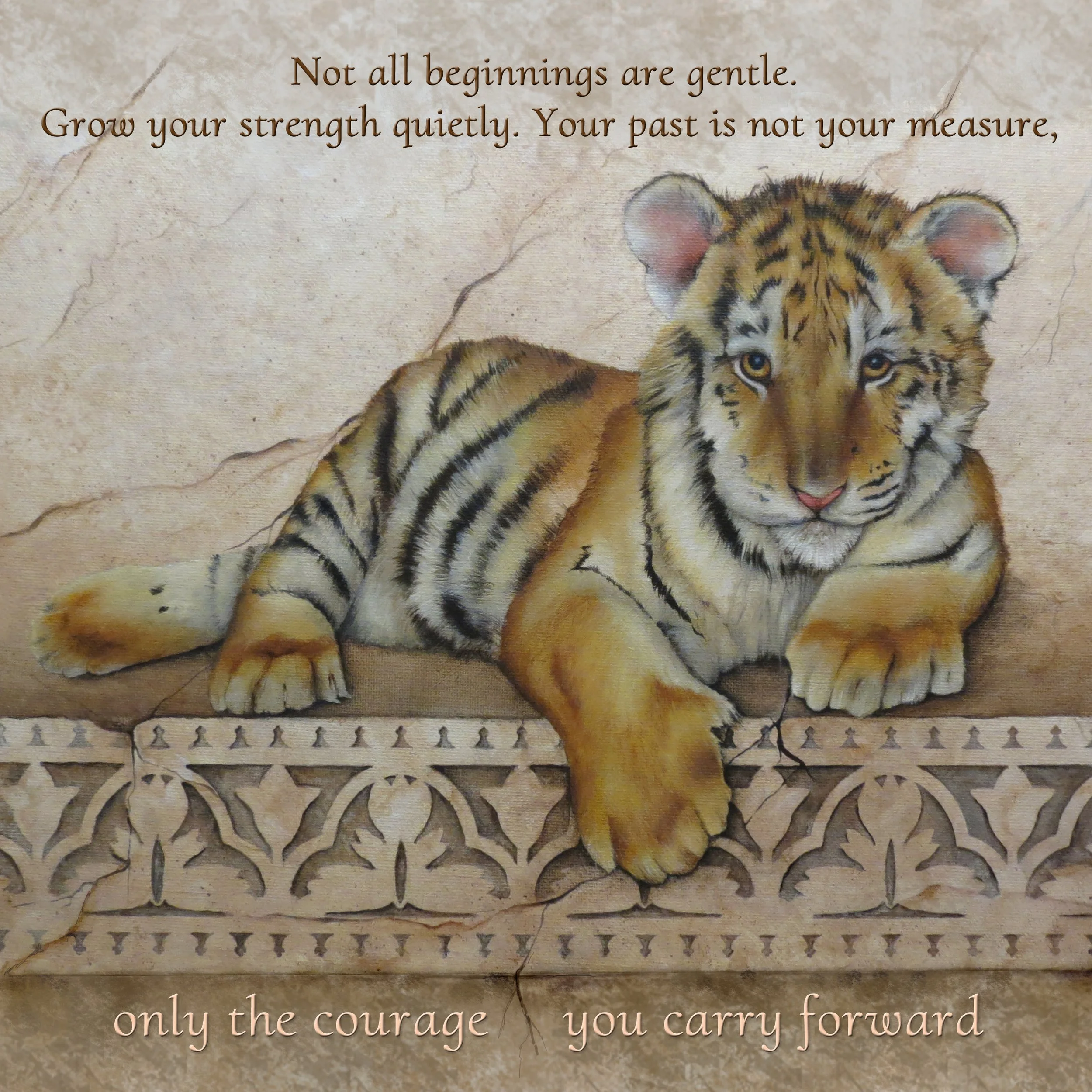
Akyra — The Early Watcher
In the Quiet Wild, not all beginnings are gentle. Some young ones learn the world too early -not through choice, but through circumstance.This tiger carries that truth. She is the strength that forms in unsafe places, the awareness born from being used, the quiet wisdom of a creature who learned to watch long before she was allowed to grow.
Her innocence was not protected, but it was not destroyed. It became something else, a sharper kind of knowing,
a resilience shaped by what she survived.
Akira reminds us that early hardship does not define your worth, only the depth of your understanding.
In the Quiet Wild, those who were once used become the ones who see clearly. Those who were once unprotected
become the ones who stand with quiet strength. She is not a symbol of tragedy. She is the proof that even in unfair beginnings, a life can still rise into its own power.
Not all beginnings are gentle.
Grow your strength quietly.
Your past is not your measure —
only the courage you carry forward.
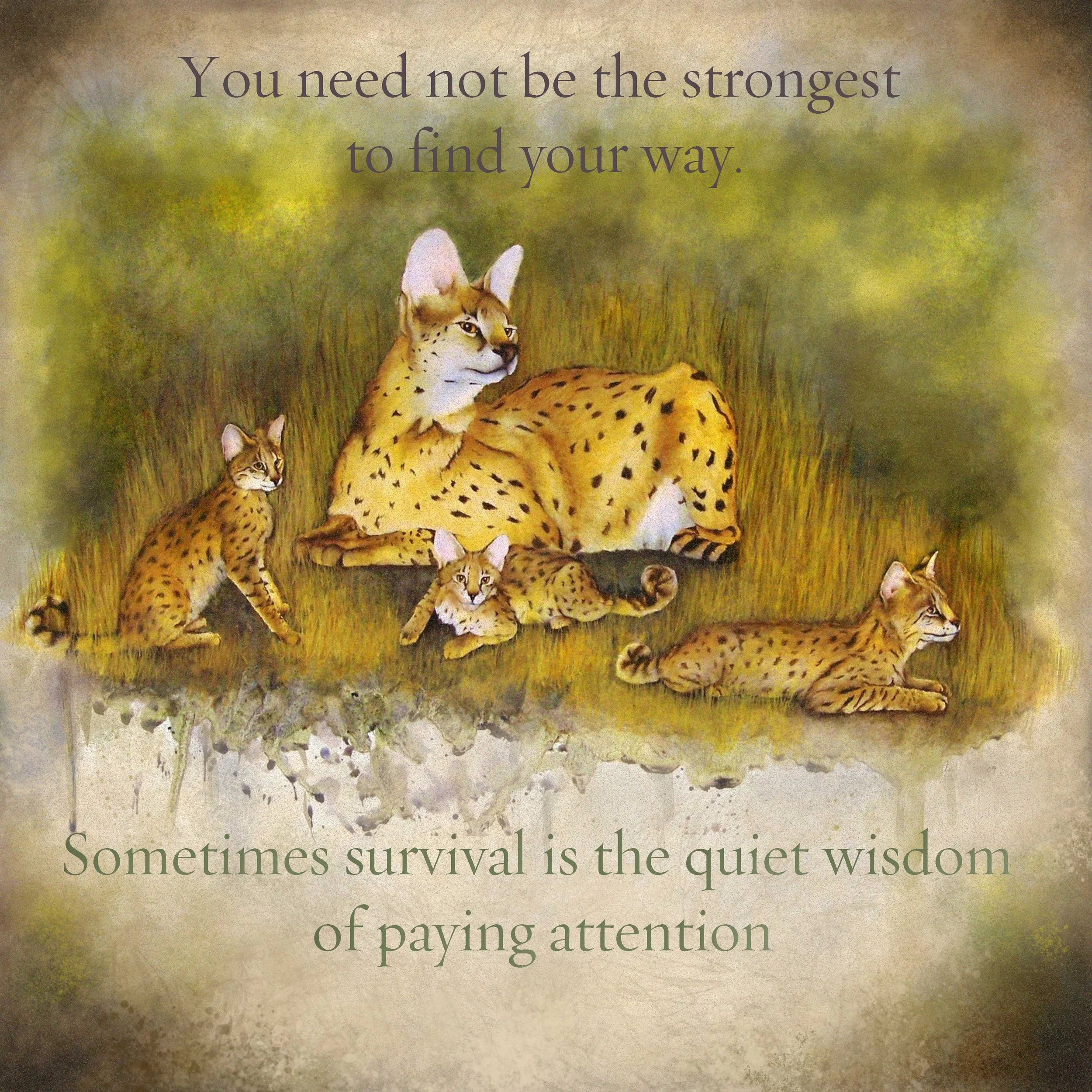
Moyo wa Nyasi — Heart of the Grasslands
The serval is not the largest hunter in the grasslands, and she never pretends to be. Her strength lives in knowing her place: the safe paths, the listening places, the pockets of grass where danger passes her by. She teaches her young this quiet wisdom long before they can hunt: how to move softly, how to read the wind, how to trust the small instincts that keep them alive.
Like the fox, she survives by attention rather than force.
By precision rather than power.
By understanding the world instead of trying to dominate it.
There is a maternal tenderness in this way of being — a steady, practical love shaped by the realities of the wild. She cannot promise her young a world without danger, but she can teach them how to meet it with awareness, patience, and the courage to stay small and clever in a landscape that favors the loud.
This card carries that teaching.
That safety can be learned.
That wisdom can be inherited.
That you do not need to be the biggest presence in the room to belong there.
Let the serval remind you that knowing your place is not limitation — it is grounding.
And that moving through the world with care is its own kind of strength.
You need not be the strongest to find your way.
Sometimes survival is the quiet wisdom of paying attention
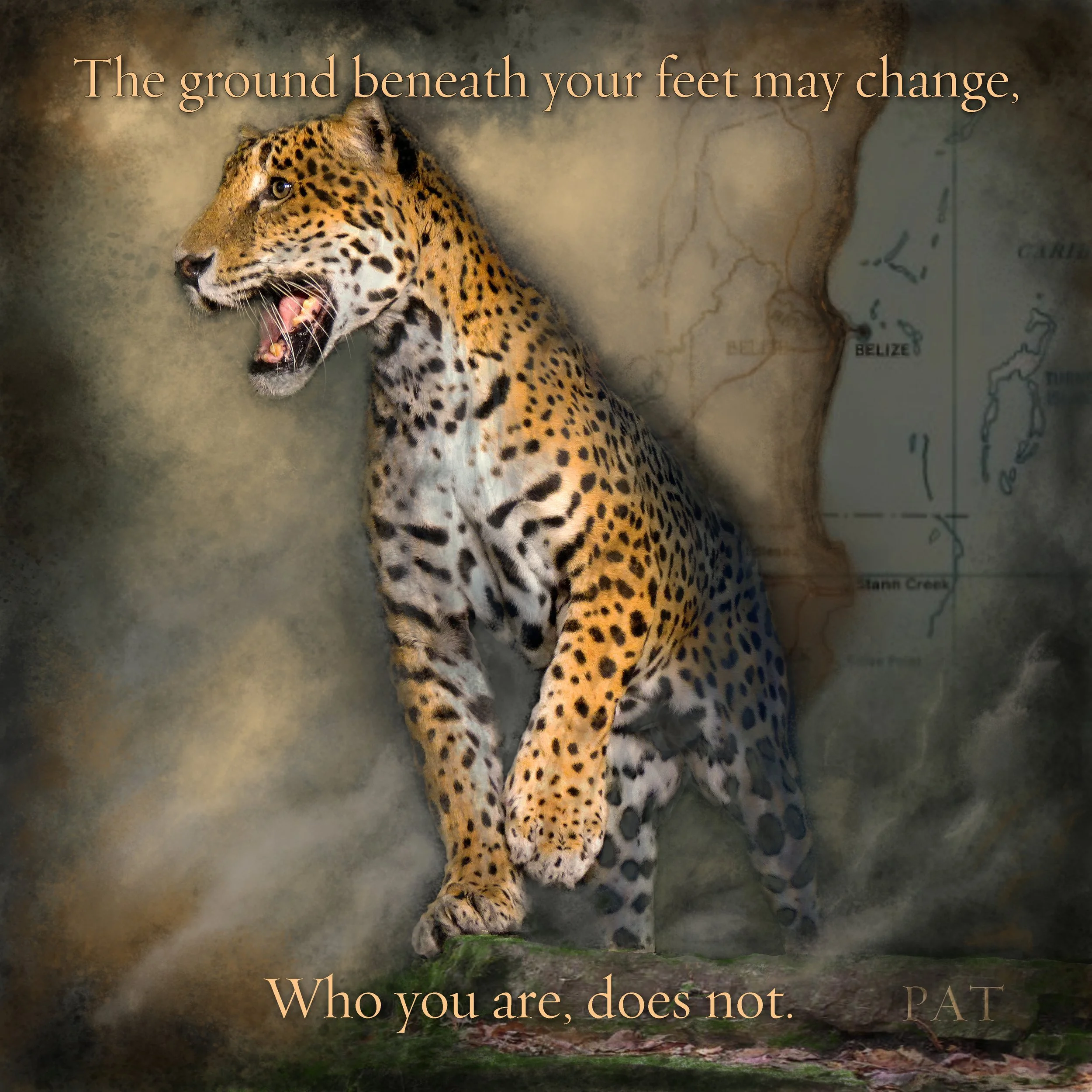
Guardians of the Displaced:
Pat the Great Cat
His Origin:
He was born in a world of thick heat and green shadow,
a place where night hums and the earth remembers every footfall.
But his path bent, lifted from the jungle he knew and carried into a colder sky.
He did not break,he adapted, carrying the old world inside him like a coal that never cooled.
His Role
Pat stands where worlds do not match. He is the one who watches over those who have been moved, uprooted,
relocated, or rewritten by circumstance.
He does not promise return, he promises recognition.
To meet Pat is to feel seen in the place where your past and present do not touch.
His Presence
He walks the perimeter of the displaced, a silent sentinel with rosettes that hold the memories of two worlds at once.When he draws near, the air warms; not with comfort, but with truth.
His Lesson
“The ground beneath you may change. Who you are does not.”
Pat’s Story is not one of creative writing, but born of true life that was actually lived. If you would like to know more please refer to the Milwaukee County Zoo for more information:
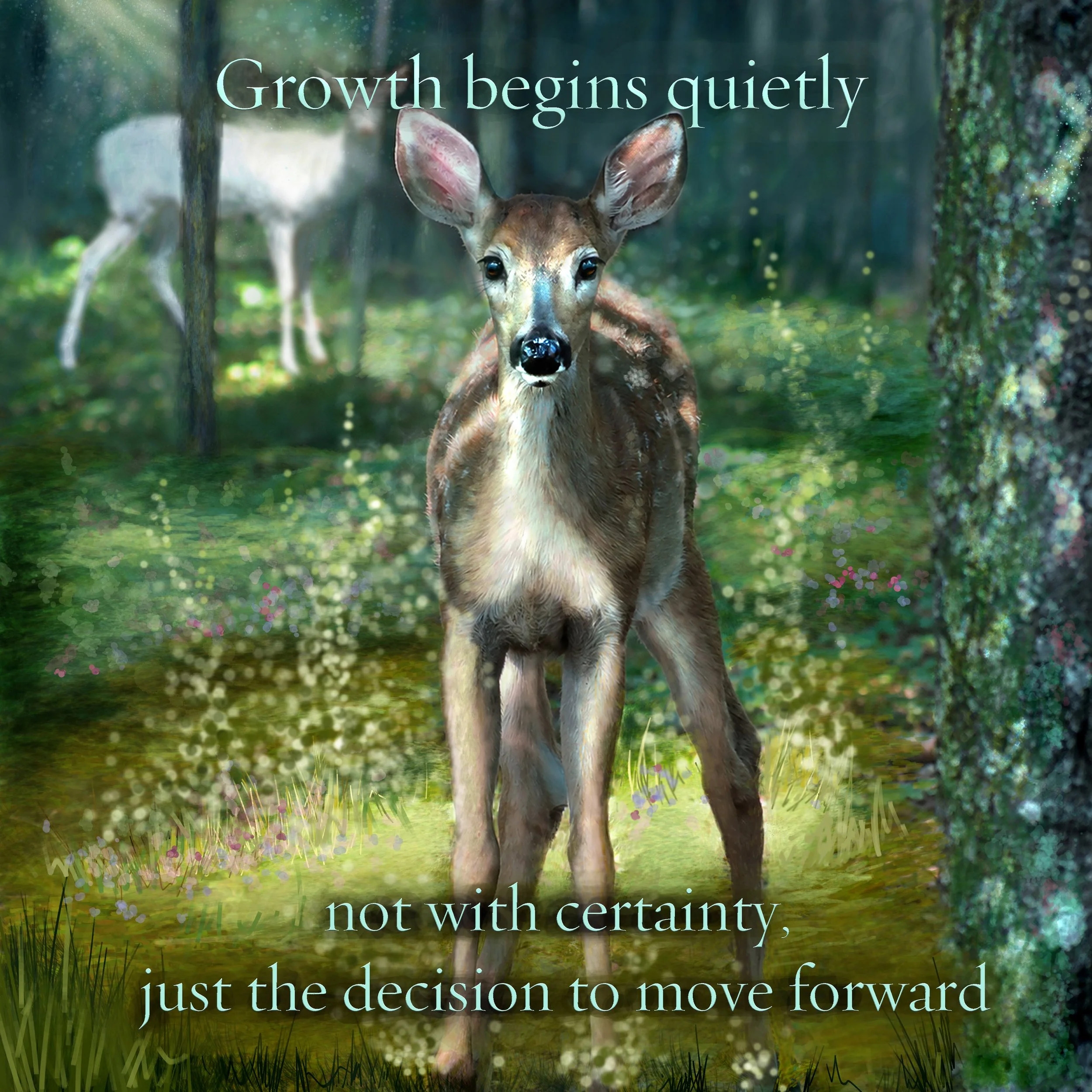
Fleeting Dawn
Spring does not ask you to be fearless. It asks you to be willing.
The young deer steps into the open not because it feels ready, but because the light has changed and something inside responds. Its legs tremble. Its breath is quick. The world is larger than it was yesterday, and that is both terrifying and true. The clearing feels unfamiliar, stretched wide by the early light, carrying the scent of thawing earth and the soft rustle of branches remembering how to move. Everything is shifting, and the fawn feels it before it understands it.
Growth begins quietly — not with certainty, just the decision to move forward. It begins in the moment you lean toward change without knowing what waits for you. It begins in the breath you take before the step, in the way your weight shifts even when your heart is unsure. Renewal is not a reward; it is a risk. It asks you to loosen the heaviness that kept you safe in winter, to release the old defenses that no longer fit, and to trust that you can survive without them.
The fawn teaches that beginnings are fragile, hesitant, and necessary. It shows that readiness is not a requirement for transformation — only responsiveness. You do not have to stride into your new life. You do not have to feel brave or certain or steady. You only have to choose movement, however small, and let that choice carry you into the next season.
You don’t have to be brave. You just have to be willing.
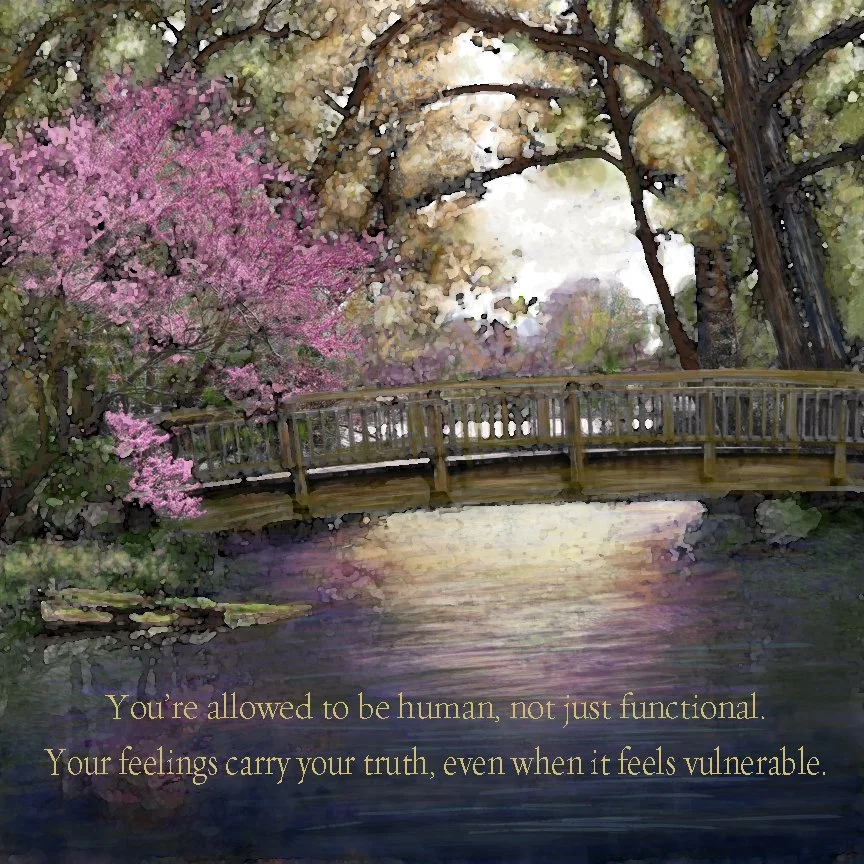
Permission
You’re allowed to feel your emotions. You’re allowed to be human, not just functional. Logic keeps you steady, but emotion keeps you alive. You’re allowed to cross between them. You’re allowed to feel, even if the world taught you not to.
There are seasons when life becomes all structure and no softness — when you move through the mundane with precision but without connection. You follow the rules, meet the expectations, keep the pace. You do what is required, and you do it well. But somewhere along the way, the world becomes sharp, efficient, and distant, and you learn to survive inside it by narrowing yourself to what is useful.
Then something gentle interrupts the pattern: a bloom, a memory, a moment of color. It arrives without announcement, without demand, without explanation. It doesn’t last forever, and it doesn’t need to. Its briefness is the point. The fallen petals prove that emotion is mortal, but real — fleeting, fragile, and still worth noticing.
The bridge stands between these two worlds: the part of you that functions and the part of you that feels. It is not grand or dramatic. It is quiet, steady, and always there, even when you forget it exists. Crossing it is not a collapse. It is not a failure of discipline. It is simply the act of remembering that you are more than your efficiency. You are allowed to step toward softness without abandoning strength.
Emotion is not the opposite of logic. It is the companion that keeps you human. It is the color in the grayscale, the warmth in the machinery, the breath in the structure. Feeling does not make you fragile; it makes you whole. You are allowed to pause, to ache, to soften, to let something inside you move even when the world expects stillness.
In the Quiet Wild, you are allowed to feel your emotions, even if no one ever taught you how. You are allowed to walk toward the color, even if it won’t stay. You are allowed to cross the bridge again and again, learning that permission is not given by others — it is chosen by you.
You don’t have to earn softness. You don’t have to justify feeling. You are allowed.
You’re allowed to be human, not just functional. Your feelings carry your truth- even when it’s vulnerable.
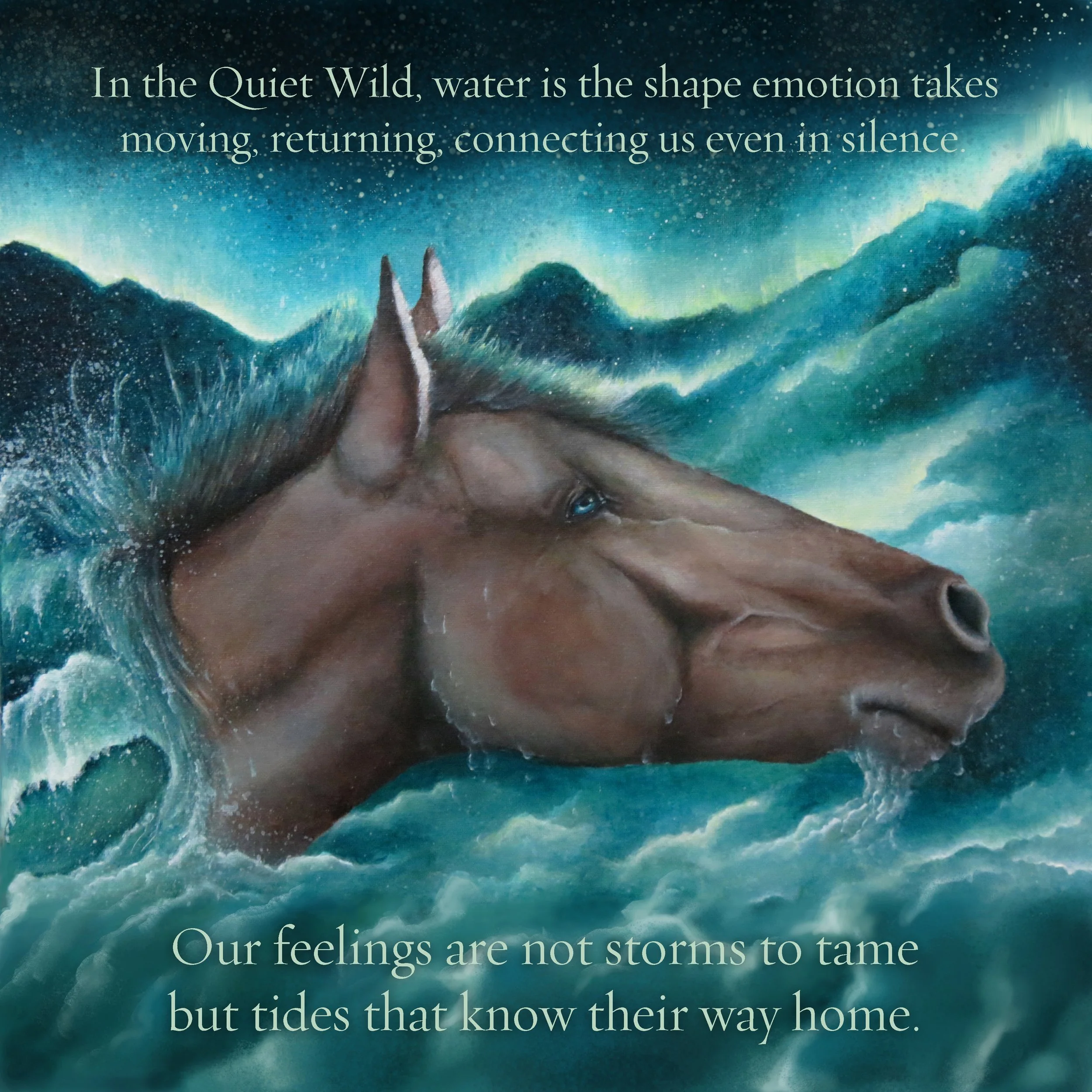
Aqua Borealis
In the Quiet Wild, water is the keeper of emotion — and sometimes it rises faster than we can breathe.
There are moments when the storm is too loud, the waves too high, and the inner voice you rely on feels impossibly far away. Overwhelm does not announce itself. It swells. It gathers. It rises in the space between one heartbeat and the next, turning familiar thoughts into currents you can’t quite navigate. You try to stay steady, but the tide keeps climbing, and suddenly even simple things feel too heavy to hold.
Aqua Borealis lives in that moment — the moment when you lift your head above the water, searching for guidance you can’t quite reach, convinced you’ve lost the connection that once felt so clear. It is the creature of emotional flood, of breathless uncertainty, of the quiet panic that comes when you cannot hear your own intuition. It does not judge the overwhelm. It simply witnesses it, shimmering in the dark water like a distant aurora, reminding you that even submerged, you are not lost.
But the truth is quieter than the storm: you are never as alone as you feel. Even when you cannot sense it, the light is still there. The current still knows the way. The ones who care for you have not disappeared — your heart is simply too full to hear them. Overwhelm muffles connection. It does not erase it. The support you cannot feel is still present, waiting for the waters to settle. The guidance you think you’ve lost is still intact, simply drowned out by the noise of your own rising tide. Aqua Borealis teaches that disconnection is often a symptom of fullness, not abandonment.
Your emotions are not storms to control, but waters that know where they need to go. Let them move through you. Let them fall away. And when the tide settles, you will feel the connection again — steady, ancient, and waiting for you. The path back to yourself is not forced. It is found in the quiet after the rush, in the soft return of breath, in the moment the water lowers enough for you to hear your own voice again. Overwhelm is temporary. Connection is enduring.
Aqua Borealis reminds you that you do not have to fight the tide. You only have to stay afloat long enough for the waters to calm.
Our feelings are not storms to tame but tides that know their way home.
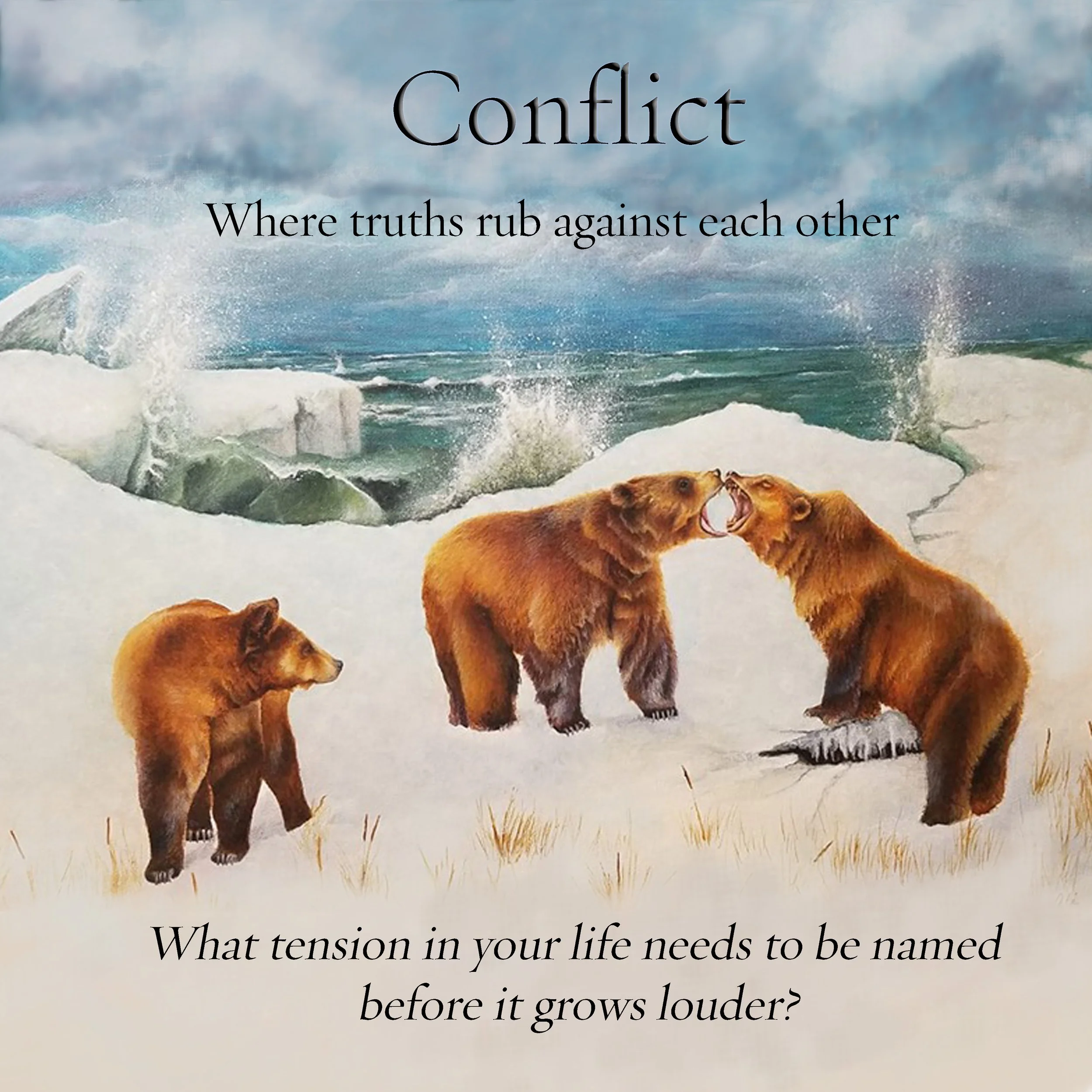
Conflict
In the Quiet Wild, even the land has moods. Some waters sleep like glass. Others wake in a fury, hurling ice into the air as if reminding every creature that calm is only one of its many faces. The Great Lakes belong to the latter — ancient, restless, and quick to turn their beauty into warning. Conflict begins here, in a world where stability can shift in an instant.
This painting holds three kinds of conflict, each one mirroring the ways tension shows up in our own lives.
Environmental Conflict — the world around you
The first is the oldest: water against ice, two forces locked in a battle of thaw and freeze, each trying to claim the shoreline. This is conflict that comes from circumstances — stress, pressure, change, instability, things outside your control. It’s the kind of clash that can lift whole slabs into the sky, reminding you that some storms aren’t personal. They’re simply happening around you.
Interpersonal Conflict — between you and someone else
The second rises between the two bears, a flare of instinct, fear, or dominance sparked by the chaos around them. When the world shakes, even companions can forget they are on the same side. This is conflict with another person — misunderstandings, reactions, hurt feelings, protective instincts. It’s the tension that erupts when external stress spills into relationships.
Internal Conflict — within yourself
The third lives in the bear who stands apart, torn between the pull of loyalty and the call of survival. He senses the danger first and wrestles with the question every creature faces when the world turns volatile: Do I stay and risk the storm, or step back and save myself? This is conflict inside you — competing values, fear vs. duty, instinct vs. truth. It’s the quiet battle between what you want, what you feel, and what you believe you should do.
None of these conflicts are villains. All of them are truths.
Most people, when they’re overwhelmed, can’t tell which one they’re actually facing. Everything feels tangled. Everything feels loud. This card exists to help untangle the knot — to help you see whether you’re reacting to the situation, the person, or yourself.
Conflict comes with choices: to fight what is not the real enemy, to flee what cannot be outrun, or to stand in the uncertain space between.
Here, on the edge of a lake with a temper, three bears show us what conflict really is — not a single story, but three unfolding at once. And when you can name the type of conflict you’re in, you can respond with clarity instead of reaction.
Not every clash is an enemy. Choose your stance with intention.
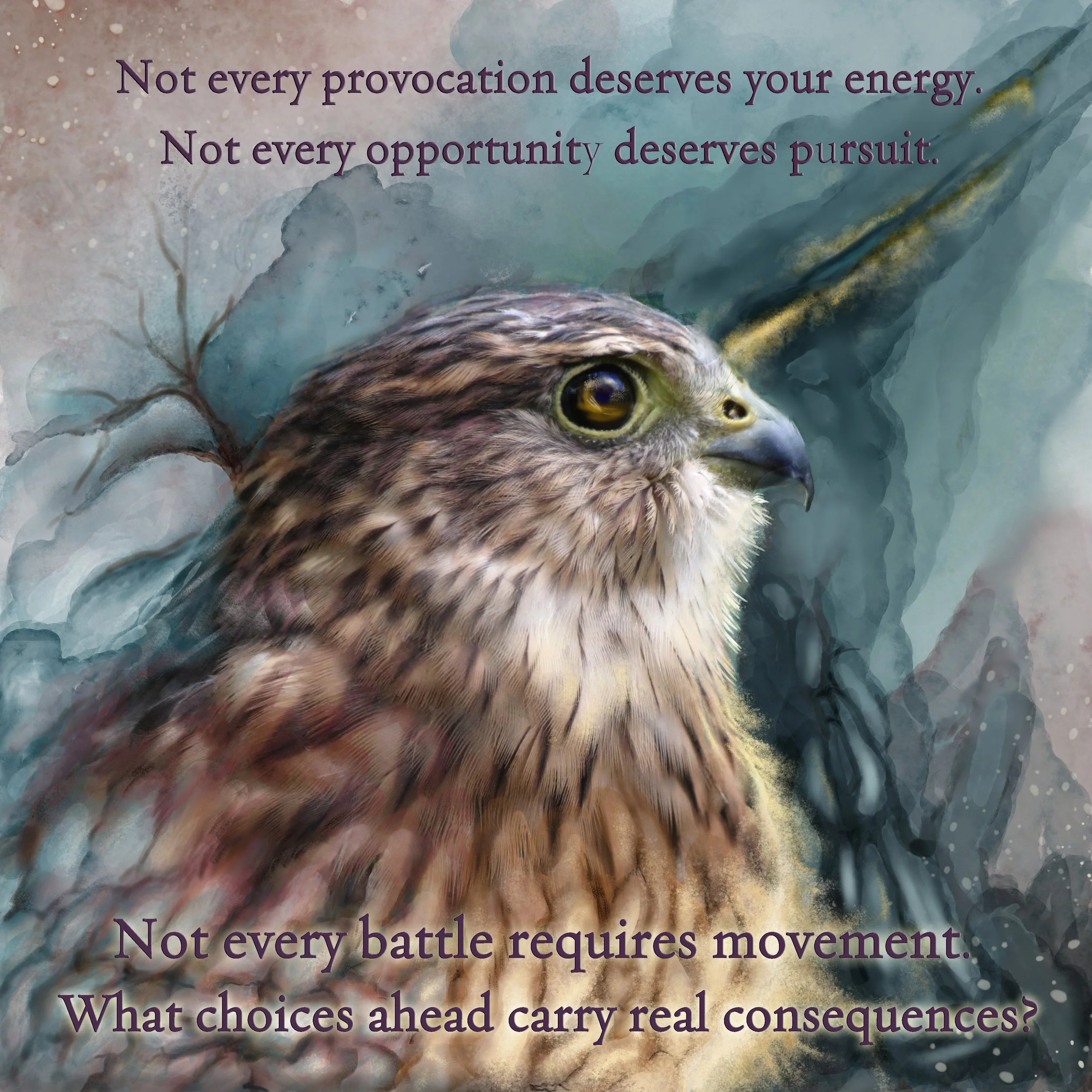
Keeper of the Measured Strike
Discernment, Timing, Precision
Not every moment is meant for action — but the right one changes everything.
In the Quiet Wild, the Merlin is known not for brute strength, but for clarity. He is a creature built for speed, yet he does not spend his life in constant motion. He waits. He watches. He studies the world with a sharp, disciplined stillness that most mistake for hesitation. But the Merlin knows a deeper truth: effectiveness comes from precision, not force.
This particular Merlin carries the wisdom of injury — a wound that once limited him but ultimately refined him. What he lost in ease, he gained in discernment. He learned that timing is survival, that instinct is only useful when paired with strategy, and that restraint is not weakness but mastery. His stillness is not fear; it is calculation. His patience is not passivity; it is power held in reserve.
Conflict, opportunity, and change all share one dangerous trait: they tempt us to act too soon. To rush. To react. To strike before we understand what we are striking at. The Merlin teaches the opposite. He teaches that clarity must come before movement, and that the world offers only a few moments where action truly matters. Those moments are rare, but unmistakable — the shift in the wind, the opening in the chaos, the breath between one heartbeat and the next when everything aligns.
Most people struggle not with action, but with discernment. They feel pressure to respond immediately, to fix, to confront, to leap. But the Merlin reminds you that wisdom often lives in the pause. In the breath you take before reacting. In the choice to observe rather than engage. In the understanding that not every opportunity deserves your energy, and not every conflict requires your talons.
Your limits, your wounds, your past missteps — these are not failures. They are refinements. They sharpen your judgment. They teach you what is worth your effort and what is not. They help you recognize the difference between impulse and intention.
The Merlin stands as an omen of the moment that matters — the one strike that changes the shape of everything that follows. His lesson is simple, but not easy:
Hold still until the truth is clear. Act only when the moment is right. Let precision, not urgency, guide your movement.
Mastery is not constant action. Mastery is knowing when to act.
Not every provocation deserves your energy. Not every opportunity deserves your pursuit. Not every battle requires movement.
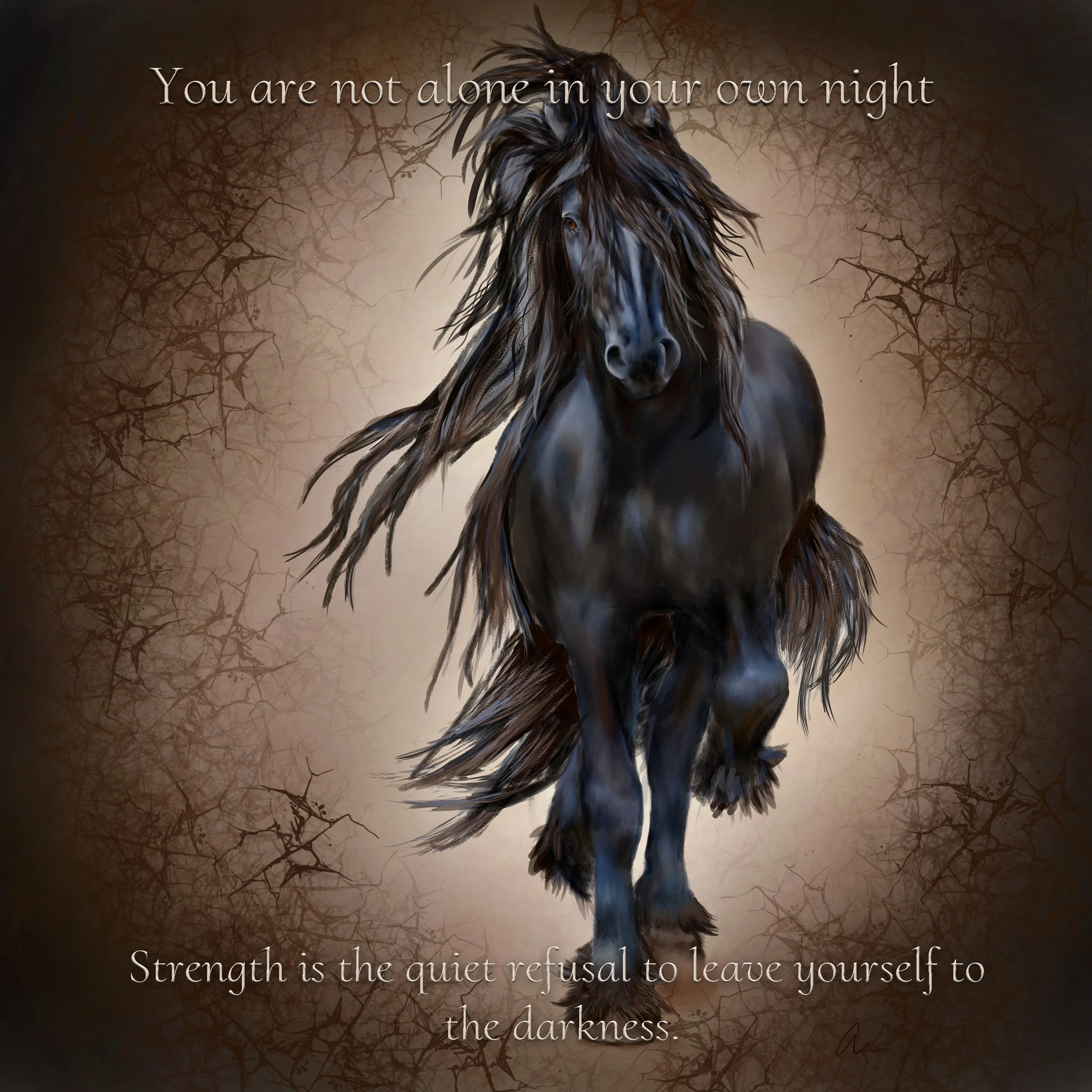
Born of Shadow and Silence
Not every strength is loud. Some are shaped in shadow, carried in silence, and revealed only when the road grows difficult. The Friesian is one of those strengths — a creature born from the first shadow cast by the first moon, made not to frighten but to guide.
In the Quiet Wild, he appears on the loneliest roads, offering his presence to travelers who have lost their way. His darkness is not a threat; it is a lantern. His motion is constant because endurance is his nature. Yet he carries a quiet curse: he may walk every path, but he may finish none. He delivers others to their destinations, then dissolves into silence before he can share in the arrival.
This curse is not punishment — it is pattern. The Friesian carries a shadowed place inside him that he never reveals. He guides others through their darkness, but he never lets anyone see his own. He offers strength but never accepts it. He walks beside others but never allows anyone to walk beside him. And because he never shares the weight he carries, he never reaches a destination of his own.
This is the heart of his lesson and the truth on the card:
You are not alone in your own night. Strength is the quiet refusal to leave yourself to the darkness.
This is the heart of his lesson. Some of us move through life the same way — steady, supportive, guiding others through storms while keeping our own shadows hidden. We know how to help, how to endure, how to walk beside someone in their night. But we often fear our own darkness, believing it is something we must carry alone.
The Friesian teaches that your darkness is not your enemy. It is your companion. It is the part of you that knows how to survive the night and lead others through it. But it is also a part that deserves to be seen — because guidance is not meant to be one‑sided. Even the strongest travelers need someone to walk with them.
This card is a reminder that endurance is not accidental. Your quiet strength is not invisible. Your shadow is not a flaw — it is a guide. But it is also a place that deserves light, connection, and rest.
You are allowed to accept the parts of yourself you keep hidden. You are allowed to let someone walk beside you. You are allowed to reach a destination of your own.
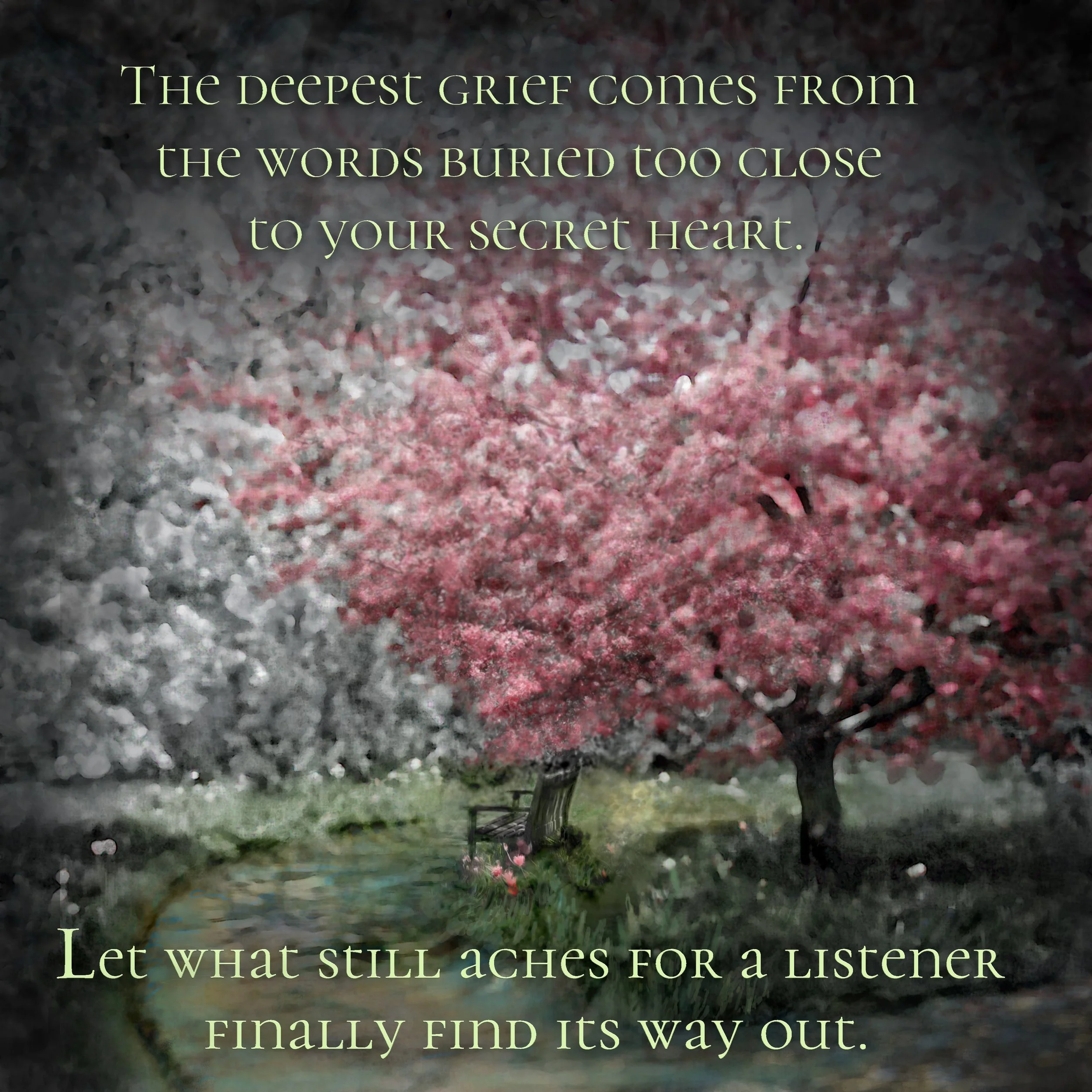
Ghosts of Unfinished Conversations
This isn’t just a bench. It is a place where words linger, where stories pause and wait for resolution. Silence gathers here — not empty, but full of everything that was never said.
The deepest grief comes from the words buried too close to our secret heart. Let what still aches for a listener finally find its way out.
Unfinished conversations have a way of echoing long after the moment has passed. A sentence cut short. A truth never spoken. A goodbye that never arrived. We carry these fragments like weight, hoping someday the missing pieces will return and complete the story.
But closure is not something another person gives you. It is not owed, promised, or guaranteed. Sometimes the one who could have answered is gone. Sometimes the moment has passed beyond reach. Sometimes the door you needed simply never existed.
The ghosts of unfinished conversations teach a harder, quieter truth: You must finish the story yourself.
Closure is not about receiving the last word. It is about releasing the ones you’ve been holding. It is the courage to speak what was never heard, to name what still hurts, to let your own voice complete what life left undone.
This bench is the place where buried words rise. Where grief finds breath. Where silence becomes witness instead of prison. Where you stop waiting for someone else to free you from what aches.
Unfinished conversations do not disappear. They soften when spoken. They settle when acknowledged. They release when you finally let them out of the quiet place where you’ve kept them.
You are not alone in this kind of grief. And you are not powerless within it.
Let what still aches for a listener finally find its way out.
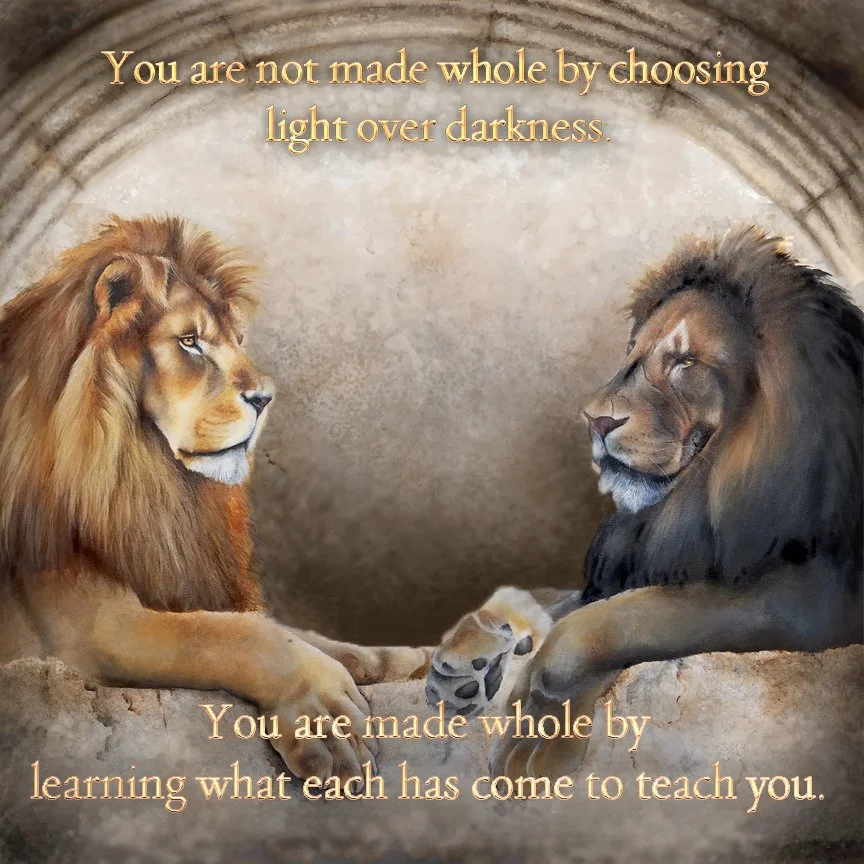
Measure of Light, The Weight of Shadow
Light reveals who we are, but shadow holds the parts we often hide. This card explores the balance between illumination and concealment the interplay of truth and mystery within us. In the Quiet Wild, these two forces are not enemies. They are companions that walk beside every life, each carrying a lesson the other cannot teach.
Light is the part of you that seeks clarity. It shows your intentions, your hopes, your desire to act with honesty. But light without truth becomes hollow; brightness that performs instead of illuminates.
Shadow is the part of you that remembers what is difficult. It holds your boundaries, your consequences, your unspoken truths. But shadow without respect becomes hunger; darkness that consumes instead of protects.
Wholeness is not found in choosing one over the other. Wholeness is found in learning what each has come to teach you.
Light asks: What must be seen clearly? Shadow asks: What must be carried with honesty? Together they ask: What part of yourself have you forgotten to honor?
Most of us lean too far into one side — chasing light to avoid discomfort, or hiding in shadow to avoid vulnerability. This card exists to help you stand in the middle, where strength is quiet, steady, and real. The Lions teach that integrity is born from both clarity and consequence, intention and truth, illumination and depth.
Hold your light with honesty. Carry your shadow with respect. Strength lives where the two finally meet.
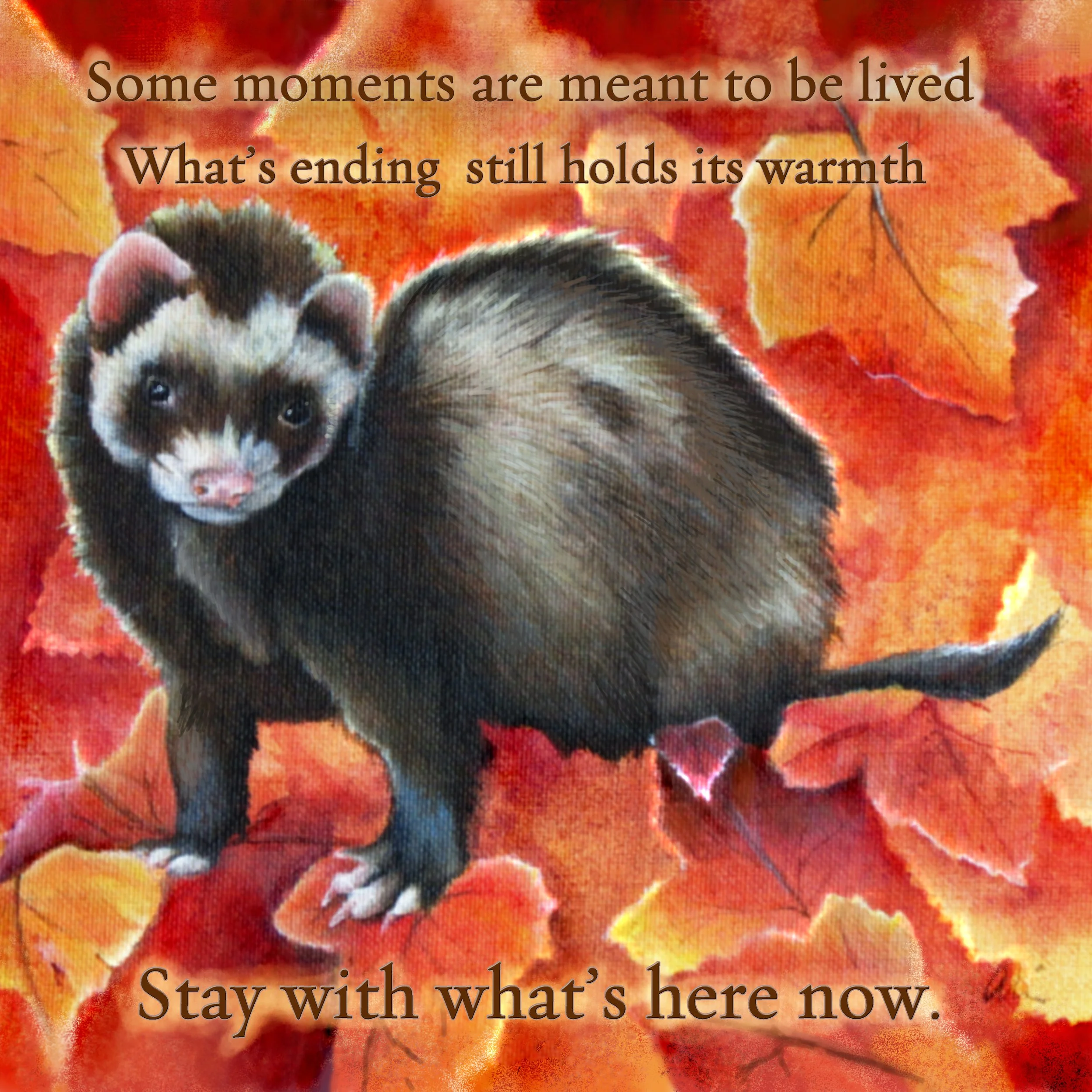
The One Who Brings you Back
In the Quiet Wild, some beings carry a light so small and steady that it can guide a wandering heart home. They do not chase away sorrow or demand that you rise. Instead, they move through the world with a joy so honest, so unguarded, that the ache of endings softens in their presence.
This little ferret is one of those guides — a keeper of bright moments, a guardian of simple delight. He appears when the world feels heavy, when the season tilts toward its closing notes, when the air carries the hush of things falling away. In rustling leaves and firelit colors, he reminds you that life still stirs beneath the quiet.
Ferrets love with their whole bodies. They investigate with their whole spirits. They meet sadness with a gentle insistence: Come back. Not all at once. Just a little.
They know that joy and grief can live side by side, and that neither diminishes the other.
Autumn is the season where beauty and impermanence walk together — where warmth lingers even as the cold approaches. Yet even here, in the season of falling things, small beings like him tug you toward the living world. They remind you that connection, play, and wonder still wait at your feet.
This piece belongs to anyone who has ever drifted from a moment that deserved to be lived — anyone who has ever needed a gentle companion to guide them back to what’s still warm, still present, still here.
Some moments are meant to be lived. What’s ending still holds its warmth. Stay with what’s here now.
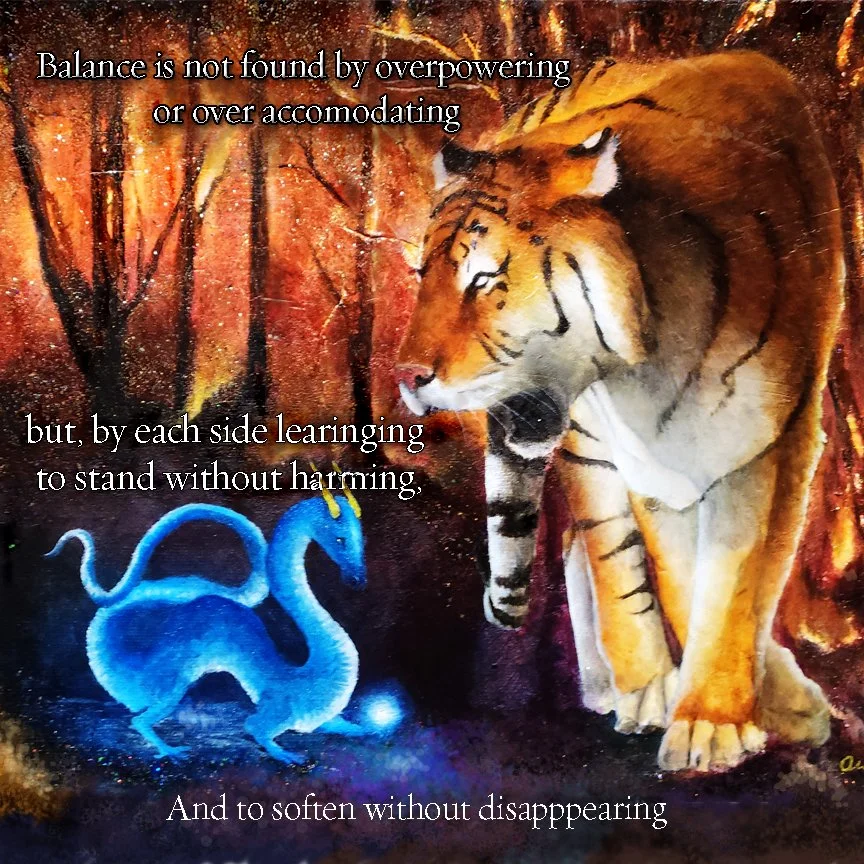
Learning the Balance of Flame and Flow
Some relationships in the Quiet Wild begin in friction. Not because either side is wrong, but because two very different energies are trying to share the same space before they understand how to move together. One arrives burning — quick to react, eager to protect, using heat to carve out safety. The other arrives in a quiet shimmer, absorbing more than he should, hoping calm alone will keep the peace.
Both mean well. Both overreach. Both misunderstand their own strength.
In the Quiet Wild, this is a familiar pattern. Flame believes that intensity will keep danger away. Flow believes that softness will keep conflict away. Both are trying to create safety — just in opposite directions.
The fire learns, in time, that not every shift is a threat, and not every boundary needs to be drawn in flame. The water learns that dissolving himself to avoid conflict is not the same as keeping harmony.
This clearing holds the moment before that understanding — a tiger burning too hot, a water dragon holding too much, two beings caught in the old dance of protection and appeasement.
The Quiet Wild teaches that balance is not found by overpowering or over‑accommodating. It begins when each side learns to stand without harming, and to soften without disappearing.
If you look closely, you may recognize yourself here. Some days you flare. Some days you fold. Some days you are both — a spark and a tide, reacting and retreating in the same breath.
Neither pattern is wrong. Both are simply signals that something inside you is trying to stay safe.
Somewhere between the flare and the ripple, a steadier kind of connection begins to take shape — a place where fire warms instead of scorches, and water steadies instead of dissolves.
This card belongs to anyone learning how to stay present in tension without losing themselves — anyone practicing the quiet art of flame and flow.
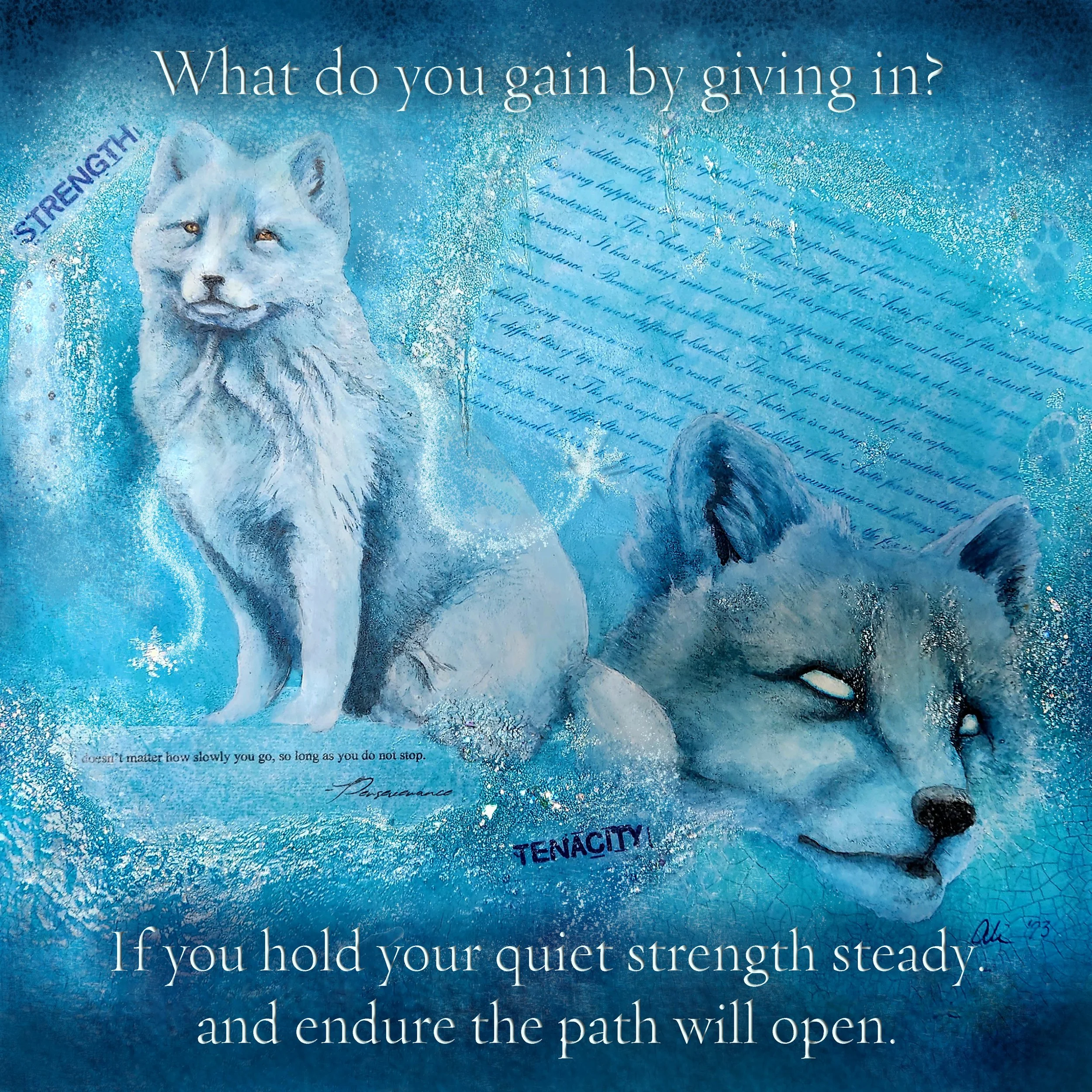
Tenacity of the Arctic Fox
Winter in the Quiet Wild is beautiful, but never gentle. The fox knows this and survives anyway. He moves through a world shaped by cold truth — a world where progress is slow, resources are thin, and only the steady-hearted endure. His presence rests in that contrast: the luminous shimmer of ice, the stark cold that takes the unprepared, and the quiet perseverance of a creature built to withstand what others cannot.
Two portraits — one grounded and steady, one close enough to feel his resolve — hold the lesson of tenacity. The fox does not rush. He does not demand ease. He simply continues, step by deliberate step, trusting that small movement still counts in a season that tests every living thing.
In the Quiet Wild, winter teaches a familiar pattern. When conditions grow harsh, many of us assume we must match the intensity — push harder, move faster, prove our strength. Others freeze, waiting for the season to pass, hoping stillness alone will protect them. The fox shows another way.
He teaches that endurance is not force. It is not denial. It is not pretending the cold is kind.
Endurance is the choice to keep moving even when the path is slow, even when the world feels stripped down to its essentials, even when progress is measured in inches instead of miles. It is the quiet belief that effort still matters, even when results are not immediate.
If you look closely, you may recognize yourself here — in the days when you keep going despite exhaustion, in the moments when you move gently through something difficult, in the seasons where your strength is quiet rather than loud.
This card belongs to anyone navigating a long winter of their own — anyone learning that tenacity is not dramatic, not glamorous, not fast.
It is simply the refusal to stop.
And in the Quiet Wild, that is enough.